
Brief History of the MINI Cooper
The new MINI has grabbed attention all over the world for its clever styling, excellent handling and reasonable ergonomics for such a small car. All of which sounds familiar to longtime fans who remember the debut of the original Mini 45 years ago. Despite the change in capitalization, the two cars share a lot in common. The first Mini was sold in 1959, and if you think the new MINI stands out from the crowd now, imagine how different it must have been back then.
Small cars were nothing new in the late 1950s. After WWII, gas was in short supply in Europe, and many manufacturers came out with "microcars" based on tiny motorcycle-sized engines. They achieved outstanding mileage at the expense of pretty much everything else. Most were cramped, stark little tin boxes that turned into portable saunas in summer and refrigerators in winter. They were noisy enough to dull your hearing and so slow they were easy prey for marauding Mopeds. The Mini was designed to take them on in the marketplace.
Alec Issigonis was a certified engineering genius with a dour disposition and a passion for finding new ways to do things. He had previously designed the Morris Minor, a sales success for British Motor Corporation (BMC), the company that made Morris, Austin, Austin-Healey, MG and several other minor marques in England. His new design was intended to be more comfortable and practical than the microcars, but by the time it came out they were already starting to be replaced in the English market by small sedans from Ford of England, Renault, Volkswagen and Fiat. The Mini would have to take on much better engineered foes than the primitive microcars had been.
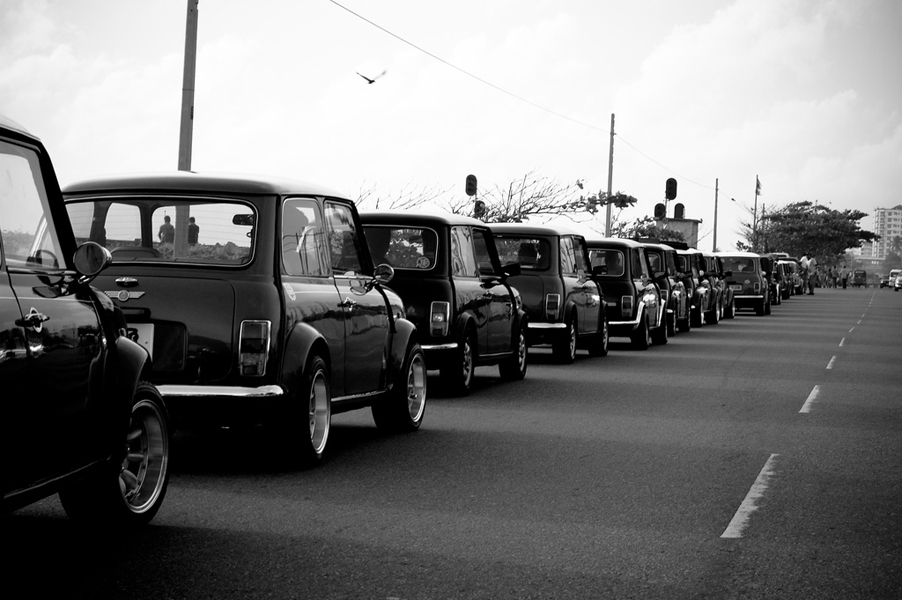
In order to keep the car as short as possible, Issigonis opted to turn the engine sideways, stuff the gearbox underneath and drive the front wheels. This approach was unusual at the time, but has since become the most common configuration for small cars. The unibody was very strong, and steel subframes at the front and rear carried the running gear and suspension. The fully independent suspension had rubber donuts in place of springs, and the tiny drum brakes rode inside 10-inch diameter wheels.
The Mini weighed only 1,300 pounds, which contributed to its excellent gas mileage. Although it looked tiny (and at ten feet long it was tiny), the interior was surprisingly roomy, with plenty of space for six footers in front. The small grille across the front had a permanent frown, but the overall effect was cute and personable. Like the VW before it, the Mini was about to become a "cult car." The first models on the market were called Austin Sevens, followed by a Morris version, the Mini Minor. Soon all models were simply called Minis.